



Sales Basics
• 8 min readObjection Handling: The Framework Top Sales Reps Actually Use
Published June 19, 2026
Published June 19, 2026
Twenty minutes into what looked like a solid discovery call, the prospect said it:
"We're already using a tool."
The objection "we're already using a tool" is one of the most predictable things a prospect will ever say. It happens on roughly 60–70% of B2B discovery calls, according to research from HubSpot. And yet, most teams still handle it the same way — with improvised responses that feel defensive, or scripted comebacks that feel robotic.
Neither works.
What works is a structured, practiced, empathy-driven approach to handling objections — one that turns resistance into dialogue, and dialogue into pipeline.
An objection is not a rejection. It's a question wearing a disguise.
When a prospect says "your price is too high," they're not saying no. They're asking: "Help me understand why this is worth the investment."
When they say "I need to think about it," they're usually asking: "I don't have enough confidence to commit yet — what am I missing?"
When they say "we don't have budget," they're often communicating: "This isn't a priority I've been given resources for — help me build the case internally."
This reframe is the single most important shift in objection handling. The moment your rep treats an objection as a signal to understand rather than an obstacle to overcome, the conversation changes completely.
Objections to sales pitches fall into four broad categories:
Recognizing which category an objection belongs to changes how you handle it entirely.
Scripts help. But they only help after reps understand the human psychology behind objections to a sales conversation.
Buyers are risk-averse, not change-averse.
Most prospects aren't opposed to changing how they do things. They're scared of making the wrong choice and having to own that decision. Every objection is, at some level, a form of risk management.
When your rep understands this, the handling of objections becomes less about "winning" the conversation and more about reducing the perceived risk of the decision. That's a very different mindset.
Three psychological principles that improve how you handle objections:
1. Validate Before You Respond
The single biggest mistake reps make in objection handling is jumping to a rebuttal before the prospect feels heard. Validation isn't agreement — it's acknowledgment.
"That makes a lot of sense" or "I hear that often, and it's a fair concern" tells the buyer: you're not crazy for thinking this, and I'm not about to dismiss it. That tiny shift drops their defensiveness by a measurable degree — and opens the conversation for a real exchange.
2. Ask the Question Behind the Objection
Every surface-level objection has a deeper concern underneath it. Reps who are good at handling objections know how to dig one level deeper before attempting to answer.
"When you say the timing isn't right — what's driving that? Is it budget cycle, or is there a competing priority I should know about?" This question does two things: it gives you real information, and it signals to the buyer that you're trying to understand, not just close.
3. Anchor to Their Own Words
The most persuasive response to an objection usually doesn't involve your product at all. It involves reflecting the buyer's own stated goals back to them, and showing how the objection creates friction with those goals.
"Earlier you mentioned that your team's biggest pain point is the amount of time spent manually following up on stale leads. If we can cut that by 60%, does the timing concern change at all?"
That's not a script. That's active listening applied to objective handling.
1: "It's too expensive."
What they really mean: The value isn't clear enough yet to justify the number.
How to handle it: Don't discount immediately — that signals desperation and anchors every future negotiation lower. Instead, shift from price to ROI.
"I understand — and I'd feel the same way without knowing how it performs for similar teams. Can I share what other companies in your space have seen in the first 90 days? That might help us figure out if the math works for you."
Then walk through a specific, quantified customer story. Numbers that come from peers are far more persuasive than numbers that come from your pitch deck.
What they really mean: Switching costs feel real, and change feels risky.
How to handle it: This is a status quo bias problem, not a satisfaction problem. Most buyers using a competitor aren't deeply delighted — they're just comfortable with what they know.
"That makes sense — and honestly, switching is a real overhead. I'm not trying to convince you to do that lightly. Can I ask: what's the one thing you wish your current tool did better? Because if that's something we solve, it might be worth at least seeing the difference."
This question de-risks the conversation and turns it into discovery, not debate.
What they really mean: Either it's not a priority, or they need help making the internal case.
How to handle it: First, separate the two possibilities. Then address the real one.
"Totally fair. Is this more of a 'the budget isn't available' situation, or is it a 'this isn't at the top of the list right now' situation? Because those are different problems — and I want to make sure I'm helpful rather than just persistent."
If it's a prioritization issue, help them build the business case. If it's a genuine budget cycle issue, ask about the right time to re-engage and get it on the calendar now.
What they really mean: Something isn't resolved — a concern, a stakeholder, a comparison they haven't done yet.
How to handle it: Don't just say "of course, take your time." That's not handling the objection — it's deferring it.
"Of course — and I want to respect that. Can I ask what the main thing is that you're still working through? I'm not trying to rush you, but if there's a question I haven't answered well enough, I'd rather deal with it now than leave you with uncertainty."
This opens the door to the real concern and shows confidence without pressure.
What they really mean: They're not convinced enough that this is urgent.
How to handle it: Create a bridge to a future conversation — but don't just say "follow up in Q3." Anchor it to their timeline.
"That's fair — when would be a better time? And is there something happening in Q3 that would make this more relevant, or is it more about capacity right now?"
Then set a specific date. "I'll send you a calendar invite for July 15th — does that work?" converts a vague future into a committed next step.
Most objection handling frameworks you'll find are three or four letters that spell something clever. Here's one that actually maps to how human conversations work.
Before responding to any objection, take a breath. Literally. The most instinctive response to an objection is defensive — and defense closes conversations. The pause signals confidence, not weakness.
Acknowledge the objection without agreeing with it. "I hear that, and it's a fair concern" or "A lot of the teams we work with said the same thing before they saw the numbers."
Validation opens the prospect up. Rebuttals shut them down.
Ask the one question that helps you understand the real concern underneath. "Can I ask what's driving that?" or "When you say [X], can you tell me more about what that means for your situation?"
This is the most underused step in handling objections — and the most powerful.
Now answer — but use their words and their priorities. Reference what they told you during discovery. Anchor your response to their stated goals, not your product features.
If you can't answer with their language, you probably need to clarify more before responding.
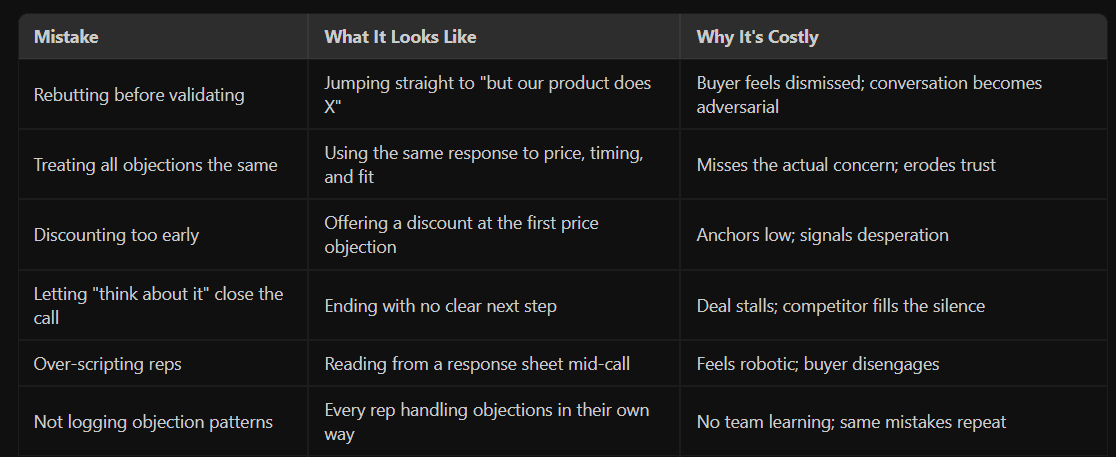
All of this — the frameworks, the psychology, the team playbooks — only works if the underlying infrastructure supports it.
And here's where most teams quietly struggle. Modern revenue teams solve this not by hiring better reps — but by building better systems around the reps they already have.
This is the kind of infrastructure that transforms objection handling from a talent-dependent skill into a team-wide capability.
Outplay is built for exactly this kind of revenue team. From multi-channel sequence intelligence that gives your reps pre-call context, to conversation tracking that surfaces what's working and what isn't — Outplay gives your team the platform to not just run sequences, but to learn from every interaction and improve how they handle objections over time.
Because the best objection handle isn't improvised. It's prepared.
Want to see how Outplay helps revenue teams track objection patterns and turn every conversation into a learning opportunity? Explore Outplay →
Share
Subscribe to the Outplay blog for your dose of expert contributions, tried and tested techniques and so much more.

