



Sales Basics
• 8 min readCustomer Engagement: A Modern Guide
Published June 18, 2026
Published June 18, 2026
Your SDR had been running a sequence for three weeks. Eight touchpoints — emails, LinkedIn, a cold call, even a voicemail that sounded genuinely human. The prospect had actually opened two emails. One of them three times.
Then nothing. No reply. No "not interested." Just silence.
Here's the painful truth: the engagement was there. The intent was there. What was missing was the strategy — the intelligence to know when to reach out, what to say, and whether that prospect was even the right person to be talking to in the first place.
But here's what's interesting: teams with a deliberate, structured customer engagement strategy still see reply rates 3–5x the industry average. They close faster. They retain more. They expand accounts more predictably.
The difference isn't the product they're selling. It's how they engage.
Customer engagement is the ongoing, intentional effort to build a meaningful relationship with a prospect or customer by delivering the right message, through the right channel, at the right moment — in a way that makes them feel understood rather than pursued.
Most definitions stop at "interactions." But in B2B sales, the customer engagement definition needs to go further.
Engagement isn't an email open. It's not a LinkedIn like. It's not even a replied email, necessarily.
True customer engagement in a B2B context means:
In other words, engagement with customer relationships is less about frequency and more about relevance over time.
Technically, client engagement and customer engagement refer to the same underlying concept. But in practice, there's a nuance:
Both operate on the same principle: consistent, value-driven interaction that builds trust over time.
For B2B sales teams, the distinction matters because client engagement strategies post-sale are often managed by a different team — CSMs, AEs, or account managers — and the handoff between them is where things often fall apart.
These three terms get used interchangeably in revenue team meetings. They shouldn't be.
Customer experience (CX) is the sum of every perception a buyer forms from every interaction with your brand — your website, your emails, your product, your support team, your social content. It's passive. It happens whether you design it or not.
Customer satisfaction is how a buyer feels at a specific moment in time — usually after a purchase, a support ticket, or a QBR. It's a snapshot. It tells you how you did, not how you're doing.
Customer engagement is active. It's the ongoing exchange of value between your team and your prospect or customer. It's dynamic, it compounds over time, and it's the only one of the three that directly predicts revenue outcomes like retention, expansion, and referrals.
The reason this matters operationally: most teams measure customer satisfaction and customer experience — but they don't have a clear framework for managing customer engagement. They don't know what good engagement looks like at each stage, who owns it, or when it's slipping.
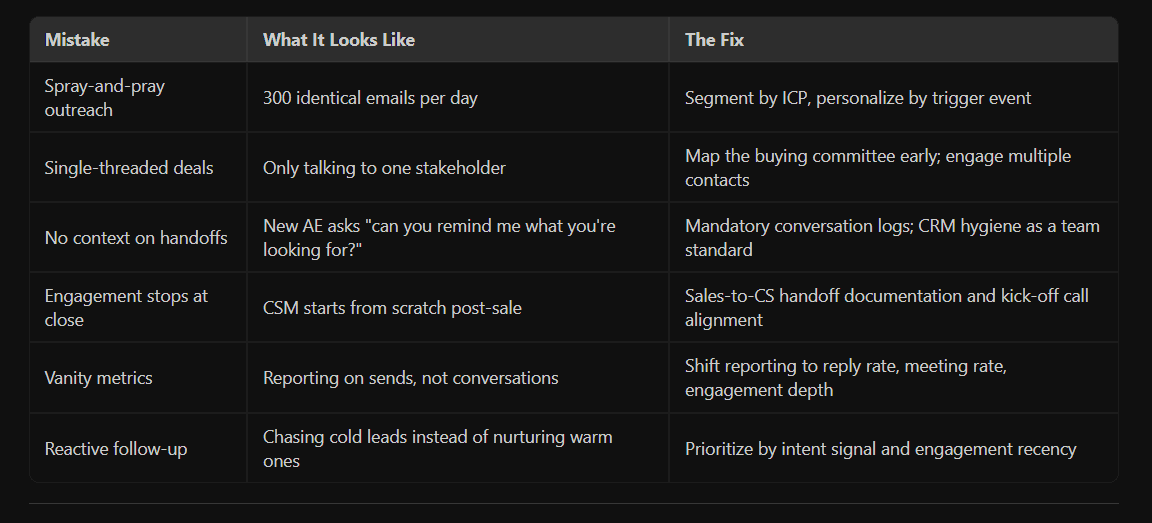
These aren't dramatic failures. They're the small, chronic habits that erode engagement over time.
1. Treating Every Buyer the Same Way
Your outbound sequence is identical for the VP of Sales at a 50-person startup and the Director of RevOps at a 2,000-person enterprise. Same emails. Same timing. Same pitch.
Buyers can feel this. Personalization isn't just putting their first name in the subject line — it's acknowledging their specific challenge, their company's current situation, and where they are in their journey. Generic outreach destroys engagement with customer relationships before they ever begin.
2. Measuring Activity Instead of Engagement
"We sent 500 emails this week" is an activity metric. "We had 47 meaningful two-way conversations" is an engagement metric.
Most SDR dashboards are filled with the former. The problem: high activity with low engagement leads to exactly the kind of burnout and pipeline dry spells that make revenue unpredictable. When teams optimize for sends, they lose sight of signals — which replies were genuine interest versus polite curiosity versus someone who just wants you to stop emailing.
3. Losing Context During Handoffs
A lead gets nurtured by marketing. An SDR qualifies them. An AE takes over. A CSM inherits the account post-close.
At each handoff, context evaporates. The new person starts from scratch, asks questions the buyer already answered, and breaks the thread of continuity that good client engagement requires.
4. Going Dark Between Touchpoints
The classic SDR problem: they fire off a sequence, wait for replies, and go quiet if they don't get one. But buyer timelines are rarely aligned with your follow-up cadence.
Deals that go cold often go cold because the rep stopped showing up — not because the buyer lost interest. Consistent, low-pressure engagement with customers keeps you relevant during the 3-4 months when your champion is internally socializing the decision.
5. Treating Post-Sale Engagement as Someone Else's Job
The moment the contract is signed, most sales teams move on. But the customer hasn't even started their journey with your product. Customer engagement post-sale is what drives expansion, referrals, and renewals — and it requires deliberate strategy, not just check-in calls.
The best client engagement strategies aren't built around products — they're built around buyer journeys. Here's the framework:
Stage 1: Signal-Aware Prospecting
Before any outreach, strong customer engagement strategies begin with understanding context. What has the prospect been doing? What's happening in their industry? Who in their org is active on LinkedIn? What is their company's strategic priority this quarter?
The engagement starts in your research, not in your first email.
Stage 2: Multi-Channel, Multi-Stakeholder Engagement
B2B deals rarely have a single decision-maker. Effective customer engagement strategy means engaging the full buying committee — at the right times, through the right channels.
Email is table stakes. Add LinkedIn, phone, video messages, and relevant content shares — all coordinated, not random. According to research from RAIN Group, buyers are 58% more likely to meet with sellers who provide proactive, relevant insights. That's a content-led client engagement strategy in action.
Stage 3: Conversation-Led Cadences
Forget "sequences" that fire on autopilot. The strongest customer engagement strategies treat each conversation as a thread — each touchpoint builds on the last, references context, and moves the relationship forward.
This requires your reps to review what was said, what was promised, and what signal the buyer gave last. It also means your sequences should adapt to replies, not just fire regardless of what the prospect said.
Stage 4: Handoff-Proof Context Documentation
As we covered earlier, when an associate moves out of a customer engagement, everything lives in the system — not in someone's inbox. Meeting notes, objection logs, champion identification, stakeholder maps. This is how you protect the engagement.
Stage 5: Post-Sale Engagement That Compounds
The most profitable client engagement strategies treat the signed contract as the beginning, not the end. Regular value check-ins, proactive insights, product education, and strategic conversations about the customer's evolving goals are all part of ongoing customer engagement.
This is where retention becomes expansion. Where one deal becomes three referrals.
The reason so many teams struggle with customer engagement isn't a people problem — it's an infrastructure problem. They have disconnected tools, manual processes, and no unified view of where each relationship stands.
Modern revenue teams solve this by treating customer engagement as an orchestrated motion, not a series of isolated activities.
This is exactly where Outplay is built differently.
Outplay isn't just a sequencing tool. It's a revenue engagement platform designed for modern revenue teams who understand that pipeline quality is a function of engagement quality. With Outplay, your team can run multi-channel outreach from a single place, capture every intent signal, keep the full engagement history visible across handoffs, and actually know — in real time — which deals are getting warm and which ones are going cold.
Curious how Outplay helps revenue teams build consistent, context-aware customer engagement across every channel? See how it works →
Share
Subscribe to the Outplay blog for your dose of expert contributions, tried and tested techniques and so much more.

