



SDR Diaries
• 7-9 mins readThe Rejection Playbook: What to Do When a Prospect Says No
Published March 13, 2026
Published March 13, 2026
Let's be honest. Rejection sucks.
You put time into researching a prospect. You wrote a decent email. You got on a call and thought it was going somewhere. Then they said no, and now you're staring at your screen wondering what went wrong.
Here's the thing though: most reps handle rejection in one of two ways. They either give up too fast, or they push back so hard they burn the relationship completely. Both approaches cost you deals that didn't have to die.
The reps who consistently hit their numbers treat rejection differently. They have a system for it. Because once you realize that "no" is rarely the whole story, you start seeing pipeline where everyone else sees dead ends.
"No" Almost Never Means "Never"
Before getting into tactics, this mindset shift matters more than anything else in this post.
When a prospect tells you no, they're usually saying one of three things:
"No, not right now" the timing is genuinely bad. The budget is frozen, they just kicked off another project, their boss said to hold spending.
"No, not the way you're pitching this" the problem might be real but your framing isn't clicking.
"No, this isn't for us at all" a true mismatch. Wrong company, wrong moment in their growth, wrong everything.
Only the third one is actually final. The first two are opportunities that most reps accidentally walk away from. Your job is to figure out which one you're dealing with before you decide what to do next.
The 5 Types of No (And How to Handle Each One)
1. "The timing is bad"
What it sounds like: "We're in the middle of a reorg right now." "The budget is locked until Q3." "We literally just signed with someone else, try us in 6 months."
What's actually happening: There's real interest here. They're not saying your product is bad, they're saying life got in the way. This is a pause, not a rejection.
What to do: Don't disappear, but also don't ping them every two weeks like nothing happened. Set a specific date to follow up and document it properly.
Something like: "Totally understand, Q3 makes sense. I'll reach back out then. Would it be alright if I sent over something useful in the meantime so you have it when you're ready to look at options?"
That one reply does two things. You got permission to stay in touch, and you gave them something before they even needed it. By the time Q3 comes around, you're not a cold email anymore. You're someone they already heard from.
What it sounds like: "We have a tool for that." "We're pretty happy with what we've got."
What's actually happening: They think the problem is solved. The key word is "think." Almost nobody is completely happy with their current setup, but they won't tell you that unless you ask the right question.
What to do: Don't start comparing features or talking down the competitor. That almost never works. Instead, get genuinely curious.
"How long have you been using them? What do you like most about it? Is there anything you wish it handled better?"
That last question is where the real conversation starts. If they have a genuine gripe, you've just been handed your pitch. If they say everything is perfect, respect it, and check back when their contract is up. Tools get acquired. Teams change. Priorities shift.
What it sounds like: "That's out of our budget." "We can find something cheaper." "We weren't expecting that number."
What's actually happening: One of three things. They genuinely can't afford it right now. They don't see enough value to justify the price. Or they're testing to see if you'll budge. You won't know which until you ask.
What to do: Don't drop the price immediately. That's the fastest way to signal that your pricing was never real to begin with.
Instead, connect the cost to an actual outcome: "I hear you on budget. Can I ask, if this helped your team book 20% more meetings in the next 90 days, what would that mean for your revenue? Because that's the kind of result we typically see with teams like yours."
You're not defending what you charge. You're helping them see it differently. If the numbers still don't work, ask if a smaller starting point makes sense. A pilot, a lower tier, a flexible start date. Sometimes a smaller yes today leads to a bigger yes later.
What it sounds like: "Let me talk to my team." "I need to run this by my manager." "Send me some info and I'll get back to you."
What's actually happening: The deal isn't dead, but it's not moving either. There's either a stakeholder you haven't spoken to, a concern they haven't named out loud, or they're just not sure yet.
What to do: This is honestly where most deals go quiet forever. You need a real next step before the conversation ends, not a vague "I'll follow up next week."
"Of course, makes total sense. Who else would be part of this decision? I'd love to get everyone in one conversation so nothing gets lost in translation. Could we find 30 minutes that works for the group?"
If they push back on a group call, ask directly what would need to be true for them to feel comfortable moving forward. Vague hesitation is almost impossible to address. A specific concern is something you can actually work with.
What it sounds like: "This just isn't something we'd ever use." "Please remove me from your list."
What's actually happening: It's a genuine mismatch. Wrong size company, wrong industry, wrong moment. And that's fine. Not every prospect is your customer.
What to do: Let it go gracefully. A clean exit is one of the most underrated things in sales.
"Completely understand, I appreciate you being straight with me. I'll take you off the list. Best of luck with everything."
That's it. Don't try one more angle. Don't send a breakup email with a clever subject line. Respect the no and move on.
The one small thing you can do: ask if anyone in their network might be a better fit. Referrals from people who said no are rare, but they happen, and they're usually warm because the person already respects how you handled it.
Write Every Rejection Down
Here's a habit that separates good reps from great ones: every time you get a no, log the actual reason.
Not just "lost" in the CRM. The real reason. What they said, what stage you were at, what you think actually happened.
After a few weeks, patterns show up fast. If you keep hearing "bad timing," maybe you're targeting people too early in their buying cycle. If "too expensive" comes up constantly, maybe your discovery process isn't building enough value before you talk about price. Rejections are a feedback loop, but only if you actually pay attention to them.
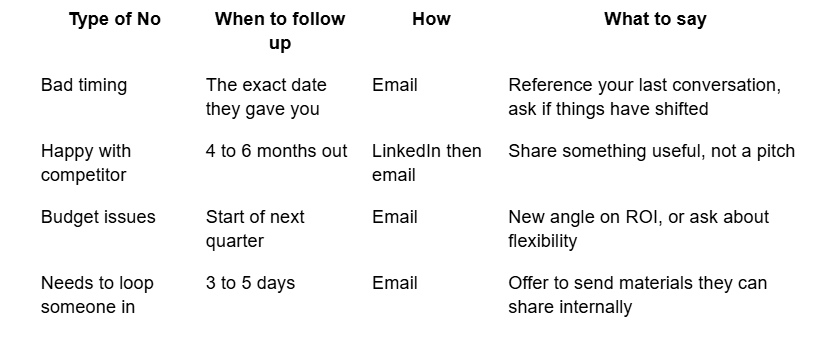
A Simple Re-Engagement Plan for the Soft Nos
For every rejection that isn't a hard no, you need a concrete follow-up plan. Not a mental note. An actual date, channel, and angle.
The biggest thing to get right here: none of these should feel like a cold email. Mention the last conversation. Show that you remember them. Make it feel like a continuation, not a restart.
What the Best Reps Actually Do Differently
They don't take rejection personally, but they also don't accept it passively. Every no is either a renegotiation, a learning moment, or a chance to qualify out cleanly and move on.
They also know that most deals close after several touches. If you fold the first time someone pushes back, you're handing pipeline to whoever is willing to stay in the game a little longer.
The goal isn't to be pushy. It's to be patient, consistent, and worth responding to. Know when to keep going. Know when to walk away cleanly. And know the difference between the two.
To Wrap Up
Rejection is part of this job. But most rejections aren't as final as they feel in the moment.
Build your playbook. Know what type of no you're dealing with. Have a real response ready instead of winging it. Log the outcomes. Run structured follow-ups for the soft nos, and let go quickly and gracefully of the hard ones.
The reps who do this don't just hit their numbers. They build pipelines that keep compounding, because the people who said "not now" six months ago are starting to say “actually, let's talk.”
Want to make sure no soft no ever slips through the cracks? See how Outplay helps you build follow-up sequences that actually run themselves. Check it out here.
Share
Subscribe to the Outplay blog for your dose of expert contributions, tried and tested techniques and so much more.

