


SDR Diaries
• 7-9 mins readThe LinkedIn DM Playbook: How to Start Conversations That Actually Convert in 2026
Published March 24, 2026
Published March 24, 2026
Introduction
You sent the cold email. You followed up twice. Still nothing.
So you go check LinkedIn and notice the prospect was active two hours ago. They liked a post. They commented on something. They are clearly not dead, not on sabbatical, and not hiding from the internet. They just did not reply to your email.
Here is the thing: their inbox is a warzone. Everyone with a CRM and a sales quota is sending them something. After a while it all blurs together, and the delete key becomes a reflex.
LinkedIn is different. Or at least, it still can be, if you use it right.
A LinkedIn DM lands in a different mental space. It feels less transactional than email. When someone gets a message there, there is social context around it. They can see who you are, where you work, who you both know. The bar for a reply is lower, because the barrier to trust is lower.
But here is the catch: most reps are ruining it. They copy-paste the same pitch they sent over email, slap it into a DM, and wonder why it does not work. The medium changed. The message did not.
This playbook is about fixing that. It covers what to say, when to say it, what to avoid, and how to fit LinkedIn into a broader outreach sequence so it actually helps you move deals forward.
Why LinkedIn Specifically, and Why Now
Cold email reply rates have been dropping for a few years now. This is not a hot take, it is just what happens when a channel gets saturated. More senders, same number of inboxes, less attention per message.
LinkedIn is holding up better for a few reasons. There is a lower volume of DMs compared to emails, so your message stands out more. There is built-in credibility from your profile. And there is a social element that makes ignoring a message feel slightly more awkward than deleting an email.
In 2026, most B2B buyers are spending real time on LinkedIn. They are reading content, commenting, posting, following people they respect. If you are only reaching out by email, you are showing up in one place and hoping for the best. Adding LinkedIn to your sequence means you are meeting people where they actually spend their attention.
None of this means LinkedIn is a magic fix. But used well, it gives you another legitimate way in.
The #1 Mistake Reps Make in LinkedIn DMs
Let us get this out of the way early because it is the most common and most damaging mistake: leading with the pitch.
It looks something like this:
"Hi [Name], I came across your profile and wanted to connect. I work at XYZ and we help companies like yours improve their sales pipeline by 3x. Would you be open to a 20-minute call to learn more?"
This is not a conversation opener. It is a pitch wearing a trench coat pretending to be a conversation opener. The prospect sees it immediately and they are out.
Think about what this message is really saying: I do not know you, I did not look at what you actually do, and I would like 20 minutes of your time to talk about myself. That is a tough sell to a stranger.
LinkedIn DMs work when they feel like the start of a genuine exchange, not a one-way broadcast. That shift in mindset changes everything about how you write.
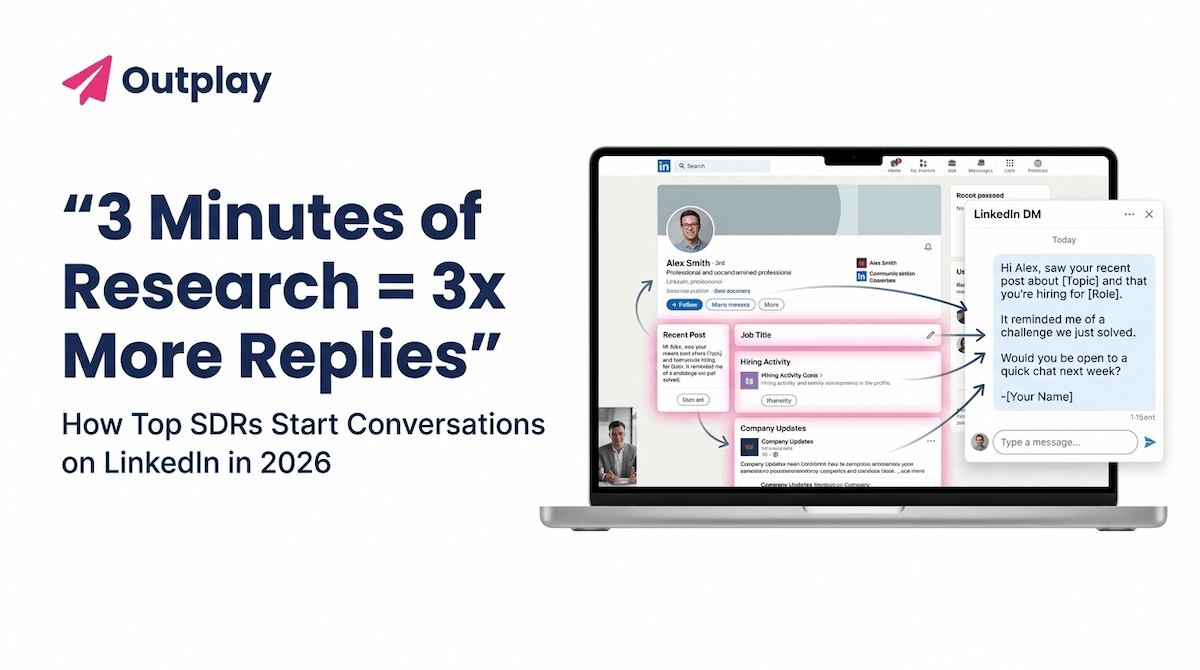
Before You Send Anything: Do Your 3-Minute Research
This step is short but it separates good outreach from spam. Before messaging anyone, spend three minutes on their profile. You are looking for:
A recent post or comment they made. This is gold. If they wrote or engaged with something in the last two weeks, you have a real, specific reason to reach out that is not about you.
Their current role and how long they have been in it. Someone who just got promoted three months ago has different priorities than someone who has been in the same seat for four years.
Shared connections. Not to name-drop awkwardly, but to understand the world they move in. If you know someone they know well, that is worth one natural mention.
Any company news. Funding, hiring pushes, product launches, rebrands. Any signal that suggests change or growth, because change creates the kind of problems your product probably solves.
You are not stalking anyone. You are just doing the minimum to make sure your message is actually relevant to the person receiving it. That is the whole point.
The Connection Request: Short Wins
If you are not already connected, you need to send a request first. And yes, always include a note. Blank connection requests from strangers feel random.
Keep the note to one or two sentences. No pitch. Just a reason to connect that makes sense.
A few formats that work:
"Saw your post on outbound sequencing last week, really good take. Wanted to connect."
"We are both connected to [Name] and I have been following your content for a bit. Thought I'd reach out properly."
"Your team is growing fast on the sales side. Doing similar work at [Your Company], thought it made sense to connect."
That is it. You are not asking for anything. You are just giving them a reason to say yes to the request.
Avoid: "I'd love to explore synergies," "We help companies like yours," or anything that sounds like it came from a pitch deck.
The Opening DM: What to Say Once You Are Connected
This is where most people overcomplicate things. After connecting, wait a day or two before sending a message. Going in immediately looks automated. Giving it a day feels human.
Your first DM has one job: start a conversation. Not book a meeting. Not explain your product. Just get them talking.
Here are a few structures that work well depending on what you found in your research:
The post angle: "Hey [Name], saw your post about [specific topic] the other day. The bit about [specific thing they said] stuck with me. Do you find that most of your team runs into that, or was it more of a one-off situation?"
This works because it proves you actually read what they wrote. It asks them a real question. And it is about them, not you.
The company signal angle: "Hey [Name], noticed [Company] just opened up a few SDR roles. Are you in the middle of building out the outbound function, or more backfilling existing capacity?"
Again, no pitch. Just a relevant question that shows you are paying attention and opens the door for them to talk about what is actually going on.
The shared struggle angle: "Hey [Name], we work with a lot of [their type of team] and the number one thing we hear is that [pain point they likely have] is getting harder. Is that hitting your team at all, or have you figured out a workaround?"
This one is slightly more forward, but it still leads with curiosity rather than selling. If they respond yes, you have all the context you need to move the conversation forward.
What all three have in common: they are short, they are specific, and they ask one question. Not three. One.
Moving the Conversation Forward
Let's say they replied. Now what?
Your instinct will be to go straight to the meeting task. Resist it. You have one reply. That is not a relationship yet.
If they answered your question, acknowledge what they said first. Actually engage with their answer. Ask a natural follow-up. You are looking to get two or three messages in before you even hint at having something useful to offer.
Once there is a little back and forth, you can start bridging toward value:
"That is interesting, we actually built [feature / approach] specifically for that scenario. Worked really well for [type of company similar to theirs]. Would it be useful if I sent over how they handled it?"
Notice the ask there is not a meeting. It is something smaller and lower-friction. A case study, a resource, a specific insight. You are offering value before asking for time.
From there, if they engage with what you send, the meeting ask becomes natural:
"Glad that was helpful. If it is relevant to what your team is working on, would a quick 15 minutes be worth it to see how it applies to your setup?"
That is a very different conversation from "Can I get 20 minutes on your calendar?"
What Not to Do: The DM Behaviours That Kill Deals
Sending the same email as a DM. Long, formal, product-heavy messages do not work in a DM inbox. The format demands something shorter and more conversational.
Following up four times in a week. One follow-up after no reply is fine. Two is pushing it. Three starts to feel like pressure and LinkedIn actually lets people mute or report messages, which is not where you want to end up.
Using automation that feels automated. There are tools that can send LinkedIn messages at scale but if the personalization layer is thin, people can tell. A message that references your company in the first sentence and ends with "would love to jump on a call" reads like a bot regardless of what tool sent it.
Connecting and immediately pitching. We covered this, but it is worth repeating because it is so common. If your connection request gets accepted and your next message is a full pitch, you are burning the goodwill the acceptance created.
Going dark after one message. If you only message someone once and never follow up, you are leaving easy conversations on the table. One thoughtful follow-up a week later is totally reasonable.
Fitting LinkedIn Into Your Outreach Sequence
LinkedIn should not be a standalone channel. It works best as part of a sequence that also includes email and calls. Here is a simple structure that works well:
Day 1: Send a cold email. Keep it short and specific to something relevant about their company or role.
Day 3: Send a LinkedIn connection request with a short note. Do not reference the email.
Day 5: If they accept, send your first DM. Use the formats above.
Day 7: Follow up on the email thread with one new piece of context or a different angle.
Day 9: If there has been engagement on LinkedIn, continue the conversation there. If not, send a short follow-up DM.
Day 14: Final email touch with a light, no-pressure close.
The idea is that each channel reinforces the others without being repetitive. You are not saying the same thing three times in three places. You are showing up in different ways, which feels less like a campaign and more like a person who is genuinely interested in connecting.
Tools like Outplay let you build multi-touch sequences that include LinkedIn steps alongside emails and calls, so you are not manually tracking who you have messaged where. That matters when you are running this process across 50 or 100 prospects at a time.
The LinkedIn DM Playbook in One Paragraph
Do your research before sending anything. Send a short connection request with a real reason to connect. Wait a day or two before messaging. Open with a question based on something specific to them, not a pitch. Let the conversation breathe before you ask for time. Use LinkedIn as one part of a multi-touch sequence, not a replacement for everything else. And write like a human being, because that is exactly what the person on the other end is.
Want to build LinkedIn steps directly into your outreach sequences? Outplay lets you run multi-channel cadences with email, calls, and LinkedIn in one place so nothing falls through the cracks.
Share
Subscribe to the Outplay blog for your dose of expert contributions, tried and tested techniques and so much more.